RN vs RPN in Canada: What's the Real Difference?
NURSING CAREER
3/11/2026
RN vs RPN in Canada: What's the Real Difference?
If you are trying to decide between becoming an RN or an RPN in Canada, you are probably wondering what the real difference actually is between the two roles. The RN vs RPN path affects your education, salary, scope of practice, and long-term career options in the Canadian healthcare system — and the answer is not as simple as most comparison articles make it sound.
I am an RPN who has worked across more settings than most nurses get to see — visiting nursing, palliative care, long-term care, RCC, and acute care at Sunnybrook Health Sciences Centre. I recently moved into an ADOC (Assistant Director of Care) role at a long-term care facility, and I am currently in the process of applying to RN programs.
I cannot tell you what it is like to be an RN from personal experience — not yet. But I can tell you what the RN vs RPN difference actually looks like from the RPN side, after years of working alongside RNs across very different clinical environments. That perspective is harder to find than you might think. When I first started out, I wish someone had explained not just what the credentials mean on paper, but what they actually feel like on the floor.
If you are still at the stage of figuring out how to become a nurse in Canada, I have a separate guide that covers the full process — education, licensing, costs, and timelines — which you can read [https://nurseincanada.com/how-to-become-a-nurse-in-canada].
RN vs RPN: Quick Comparison
Category RPN RN Education 2-year diploma 4-year degree School type Community college University Licensing exam REx-PN (ON/BC) or CPNRE (other provinces) NCLEX-RN Hourly wage (Ontario) $28 – $38/hr $38 – $52/hr Annual salary (Ontario) ~$55,000 – $75,000 ~$75,000 – $100,000+ Patient scope Stable patients Complex/unstable patients Critical care / ICU Limited Yes Nurse Practitioner path No Yes (with grad school)
Education Requirements
RPN Education
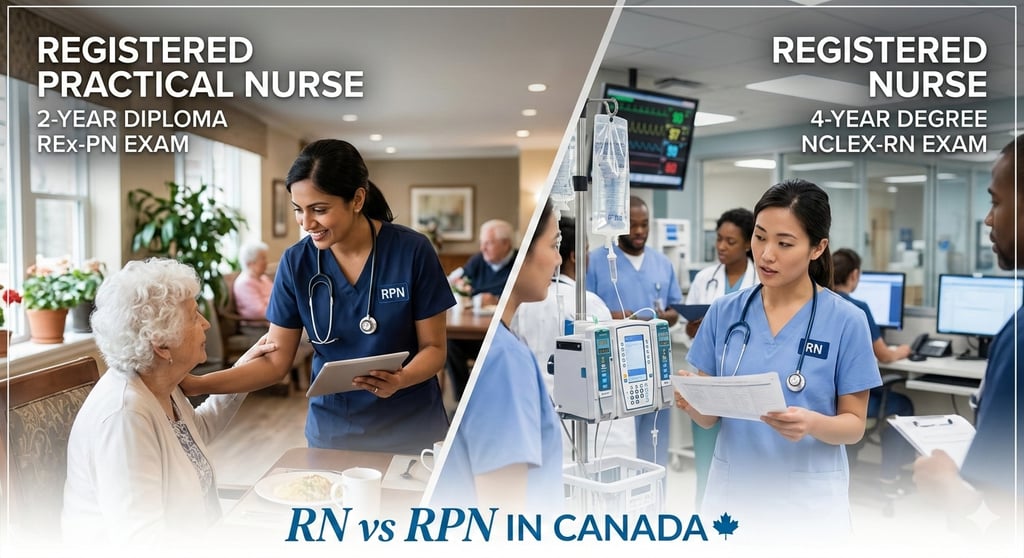
RPNs complete a two-year Practical Nursing diploma at a community college. The program combines classroom learning with hands-on clinical placements in hospitals, long-term care facilities, and community settings. Graduates are eligible to write the licensing exam immediately after completing the program.
RN Education
RNs complete a four-year Bachelor of Science in Nursing (BScN) at a university. The program covers complex patient care, pathophysiology, research, leadership, and a broader range of clinical environments. Graduates write the NCLEX-RN to become licensed.
The four-year commitment and university tuition make the RN path a bigger investment — but it also opens more doors long-term.
Licensing Exams
The licensing exam you write depends on both your credential and the province where you plan to work.
For RPNs:
Ontario and British Columbia use the REx-PN (Regulatory Exam – Practical Nurse), which replaced the CPNRE in January 2022
All other provinces — including Alberta, Saskatchewan, and Manitoba — continue to use the CPNRE (Canadian Practical Nurse Registration Examination)
If you are not sure which province you will be working in, this is worth checking in advance, as the exam is different depending on the province.
For RNs: All provinces use the NCLEX-RN.
What the Scope Difference Actually Looks Like at Work
Here is something no comparison article tells you: the gap between RN and RPN work looks completely different depending on where you work.
In long-term care, RPNs often carry a full patient load, lead care planning, supervise PSWs, and act as the most responsible nurse on the floor for their assigned residents. The work is demanding, the clinical skills are real, and the autonomy is significant. I have worked LTC floors where the RPN role felt nothing like the "limited scope" description you read online.
In acute care at a place like Sunnybrook, the picture shifts. Certain units or patient populations require RN coverage. RPNs in acute care often work alongside RNs, and there are assignments that fall outside RPN scope — unstable patients, certain ICU settings, complex critical care situations. That does not mean RPNs are not valued in acute care. They absolutely are. But the scope boundaries become more visible in that environment.
In community nursing and visiting nurse roles, RPNs carry caseloads, make independent clinical decisions in patients' homes, and often work without a colleague nearby. It requires strong clinical judgment and communication skills.
The point is: scope of practice is not just a policy document. It plays out differently depending on your setting, your patient population, and your unit culture.
Salary: Honest Numbers
Salaries vary by province, employer, and collective agreement. Ontario numbers tend to look roughly like this:
Role Approximate Hourly Approximate Annual RPN $28 – $38/hour $55,000 – $75,000 RN $38 – $52/hour $75,000 – $100,000+
The gap is real, and it compounds over a career. An RN in Ontario with ten years of experience will typically out-earn an RPN at the same experience level by a meaningful margin.
That said, RPNs who move into supervisory or administrative roles — like ADOC positions in LTC — are compensated differently, and the gap narrows in those cases.
Job Demand: RN vs RPN in Canada
Both RNs and RPNs are in demand across Canada, but the type of demand differs.
RPN demand is strongest in long-term care, complex continuing care, and community health settings. Ontario's LTC sector in particular relies heavily on RPNs, and the sector continues to face staffing shortages. If you want to find work quickly after graduating, the RPN path offers strong employment prospects — especially in LTC.
RN demand is strong across all settings, including hospitals, public health, community agencies, and specialized clinical areas like ICU, ER, and oncology. Hospitals in urban centres often prefer or require RN coverage for certain units. The nursing shortage in Canada affects both credentials, but RNs tend to have more flexibility in where they can work.
Career Paths: Where Each One Goes
RPN career paths are broader than most people expect when they are starting out.
Based on my own experience and what I have seen around me, RPNs can work in:
Long-term care (and move into charge, supervisory, and DOC/ADOC roles)
Community and home care (visiting nursing, palliative, case management support)
Rehabilitation and complex continuing care (RCC)
Acute care hospitals
Occupational health
Clinics and primary care settings
RN career paths include all of the above, plus:
ICU, ER, and other critical care environments
Clinical educator roles
Nurse Practitioner (NP) — requires additional graduate education
Management and director-level roles
Research and policy roles
The honest version: if you want to work in critical care, become a Nurse Practitioner, or have the most flexibility in where your career can go long-term, the RN credential matters. If you want to enter the workforce sooner, work in a wide range of meaningful settings, and potentially move into leadership within long-term care or community health, the RPN path is a legitimate and full career — not just a stepping stone.
The Bridging Option: RPN to RN
Many RPNs eventually consider going back to school to complete a BScN — I am currently in that process myself.
Most Ontario universities offer RPN-to-BScN bridging programs. These programs typically take two to three years rather than the full four, because they give credit for your existing nursing education and experience.
A few things worth knowing about this path:
It is not automatic. Bridging programs are competitive. Your GPA from your RPN program matters more than most people expect — strong grades can make a real difference when applying. Some universities also require the CASPer test, which is a situational judgment assessment used by many health professional programs in Canada.
Working while studying is possible but hard. Many RPNs continue working casual or part-time during their bridging program. It is manageable, but it requires real planning.
Your clinical experience counts. Having worked across multiple settings gives you a level of contextual understanding that goes beyond what a student entering nursing straight from high school has. That experience shows in applications and in the classroom.
So Which One Should You Choose?
Choose the RPN pathway if:
You want to enter the workforce in two years rather than four
You are working with a tighter budget for education
You are not sure yet where nursing will take you and want to start working
Long-term care, community health, or palliative care interest you
You are open to bridging to RN later if your goals shift
Choose the RN pathway if:
Critical care, ICU, or ER nursing is where you want to work
You are interested in becoming a Nurse Practitioner eventually
You want the broadest possible scope from the start
You have the time and financial support to commit to four years
If you are already an RPN considering bridging: Your clinical experience is an asset. The nurses I have worked with who bridged from RPN to RN brought a level of practical groundedness that I genuinely respect. Keep your GPA strong during your RPN program — it matters when the time comes to apply.
A Note for International Students
If you are coming to Canada from another country, this RN vs RPN decision carries extra weight because it affects your immigration planning, tuition costs, and timelines.
International tuition for RPN programs generally runs $18,000 to $25,000 per year, while RN programs can run $30,000 to $45,000 per year. The two-year RPN program is a more accessible entry point for many international students who want to establish themselves in Canada before deciding whether to bridge.
That said, some provincial immigration streams favour RNs over RPNs. It is worth researching the provincial nominee programs (PNPs) in the province where you plan to work before committing to either path.
Frequently Asked Questions
Is RPN the same as LPN? In most Canadian provinces the title is LPN (Licensed Practical Nurse), while Ontario uses RPN (Registered Practical Nurse). The roles are equivalent in scope and both require passing a practical nurse licensing exam — either the REx-PN or the CPNRE depending on the province.
Can RPNs work in hospitals in Canada? Yes. Many hospitals employ RPNs, particularly in medical-surgical units, rehabilitation, and complex continuing care settings. However, certain units — such as ICU or ER — typically require RN coverage.
Is RN better than RPN in Canada? Neither is objectively better. The RN provides a broader scope of practice and more long-term career options, including critical care and advanced practice roles. The RPN offers a faster and more affordable path into nursing, with strong employment prospects particularly in LTC and community health. The right choice depends on your goals, timeline, and circumstances.
What licensing exam do RPNs write in Canada? It depends on the province. Ontario and BC use the REx-PN, which replaced the CPNRE in January 2022. All other provinces, including Alberta and Saskatchewan, still use the CPNRE. Always confirm with the regulatory body in the province where you plan to register.
Can an RPN become an RN? Yes. Most Ontario universities offer RPN-to-BScN bridging programs that take approximately two to three years, giving credit for previous nursing education and experience. GPA and in some cases CASPer results are part of the application process.
Final Thoughts
The RN vs RPN comparison in Canada is not really about which one is better. They are two different nursing credentials with different scopes, education paths, and career options — and both lead to real, meaningful careers in the Canadian healthcare system.
What matters more than which credential you choose is understanding what each one actually looks like on the floor. The RPN scope is broader in practice than most people realize going in. The RN scope opens doors that the RPN credential cannot, particularly in critical care and advanced practice.
I have worked as an RPN across a range of settings, and I am currently working toward my RN. If you have questions about what the day-to-day actually looks like — especially in LTC, palliative, community, or acute care — feel free to leave a comment.
Requirements, scopes of practice, and salary ranges can vary by province and employer. Always verify current information with the nursing regulatory body in your province.
Contact
Questions or stories? Reach out anytime.
Social media
contact@nurseincanada.com
© 2025. All rights reserved.
Will update.