Should You Study Nursing in Canada or Go Through NNAS? A Realistic Guide for International Nurses
NURSING CAREER
3/18/2026
Should You Study Nursing in Canada or Go Through NNAS? A Realistic Guide for International Nurses
If you're an internationally educated nurse thinking about working in Canada, you've probably asked yourself this question more than once:
Do I go through NNAS — or do I just study nursing here?
On paper, NNAS feels like the shortcut. You're already a nurse — so why would you spend years studying again?
But the reality is more complicated than that. And I say this not just as someone who researched it — but as someone who has been working as a nurse in Canada for over 8 years, currently as an Associate Director of Care (ADOC) in a long-term care facility.
Let me break this down honestly.
First, What Are the Two Paths?
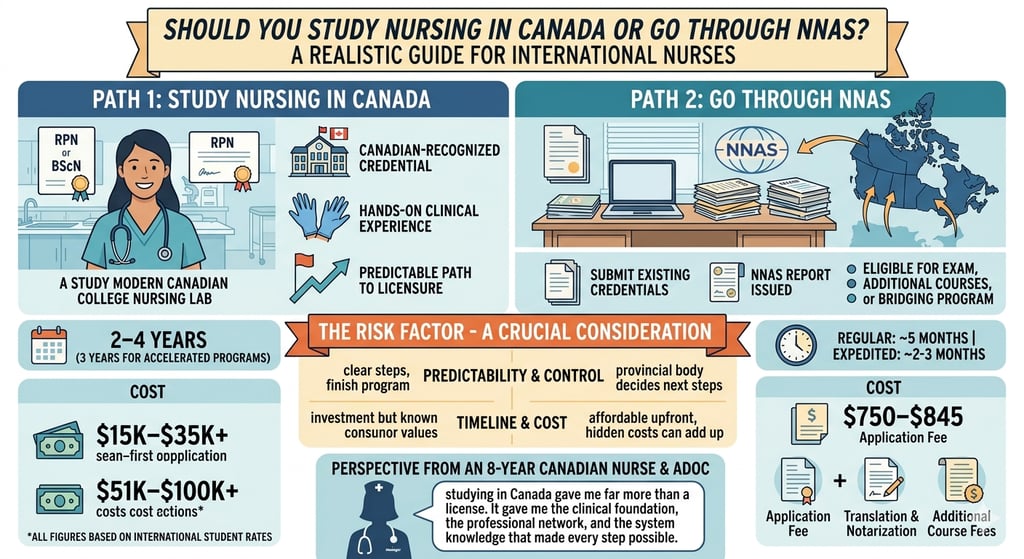
Path 1: Study Nursing in Canada
You enroll in a Canadian nursing program — like an RPN (Registered Practical Nurse) program or a BScN — graduate, and write the licensing exam.
This gives you:
A Canadian-recognized credential
Hands-on clinical experience in the Canadian healthcare system
A predictable path to licensure
Path 2: Go Through NNAS
NNAS (National Nursing Assessment Service) assesses your existing nursing education and credentials from your home country.
You submit your nursing school transcripts, proof of registration, and work experience. NNAS then sends a report to your provincial regulatory body (like the CNO in Ontario), which decides your next steps.
Possible outcomes:
You're eligible to write the licensing exam directly
You need to complete additional courses
You need a bridging program
Sounds reasonable — and for some nurses, it works out well. But there's more to understand before you decide.
Time: Which Path Is Actually Faster?
NNAS Timeline
The NNAS process itself has actually improved significantly. The expedited service now averages around 2–3 months, and the regular service around 5 months for the assessment portion.
But NNAS is only the first step.
After your report is issued, it goes to the provincial regulatory body (like the CNO in Ontario), which then decides whether you're eligible to write the licensing exam — or whether you need additional courses or a bridging program. That next stage is where timelines can become unpredictable.
For nurses who need additional upgrading, the full journey from NNAS application to being licensed and working can still take 1.5 to 3+ years in total.
Canadian Nursing Program Timeline
RPN programs: approximately 2 years
BScN programs: approximately 3–4 years (some accelerated programs run 3 years)
Yes, it's longer on paper. But the key difference is: it's predictable. You know exactly when you'll finish, and what comes next.
Cost: Which Is Actually Cheaper?
All figures below are based on international student rates.
NNAS — the real cost picture
The NNAS application fee runs $750–$845 CAD depending on whether you choose the regular or expedited service. That part is relatively affordable.
But factor in:
Document translation and notarization — required for all foreign documents, costs vary by country and number of documents
Additional courses or a bridging program if the regulatory body determines you're not fully equivalent — these carry their own tuition costs
Lost income if you're waiting months before you can work as a nurse
If the process goes smoothly and you're deemed equivalent, NNAS can be a genuinely cost-effective path. If it doesn't, the hidden costs add up quickly.
Canadian Nursing Program — the real investment
RPN / Practical Nursing diploma (2 years): roughly $15,000–$35,000+ in total tuition, depending on the college
BScN degree (3–4 years): approximately $17,000–$25,000 per year, which adds up to $51,000–$100,000+ over the full program. The national average for international undergraduate nursing tuition was around $25,800/year for 2024–2025
It's a significant investment. But you're getting Canadian clinical hours, a recognized credential, and a direct path to licensure — with no uncertainty about the outcome.
And one thing worth keeping in mind: while you're going through NNAS and waiting on regulatory decisions, you likely can't work as a nurse. That delayed income can quietly close the cost gap between what looks "cheap" and what actually ends up costing more.
The Risk Factor — This Is the Big One
With NNAS, the assessment itself is now fairly streamlined. The bigger variable is what happens after — when the provincial regulatory body reviews your report and decides next steps.
You could be an experienced nurse with years of clinical work behind you and still be told your education doesn't fully meet Canadian equivalency standards. There's no guaranteed outcome, and the timeline after NNAS is largely out of your hands.
With a Canadian nursing program, the path is clear: finish the program, pass the exam, get your license. It's not easy — but it's predictable.
My Perspective — Why I Never Had to Choose
Here's something most guides won't tell you: not everyone can even do NNAS.
I came from South Korea, where I completed two years of a nursing program before immigrating to Canada. Because I didn't finish my degree, NNAS was never an option for me. There was no assessment to submit — I simply didn't have a completed nursing credential to assess.
So I enrolled in an RPN program in Canada, finished it, and started working.
That was over 8 years ago.
Since then, I've worked across a wide range of settings — as a visiting nurse, a PSW, in palliative care, at a veterans centre, in an acute unit, a retirement home, and a complex continuing care facility. I've seen the Canadian healthcare system from a lot of different angles. Today, I work as an Associate Director of Care (ADOC) in a long-term care facility.
Would NNAS have given me that trajectory? I honestly don't know — because it was never on the table for me. But what I do know is this: studying in Canada gave me far more than a license. It gave me the clinical foundation, the professional network, and the system knowledge that made every step after graduation possible.
If you're on the fence, here's my honest take: don't just think about which path is faster or cheaper on paper. Think about where you want to be in 5 years — and which path actually gets you there.
If I had the option back then, would I still choose to study in Canada instead of going through NNAS? Honestly — yes. Because what I gained wasn't just a license. It was the ability to actually function and grow within the Canadian healthcare system.
So Which One Should You Choose?
NNAS might make sense if:
You have a completed nursing degree from your home country
Your education closely matches Canadian nursing standards
You have strong, recent clinical experience
You're prepared for the possibility of additional requirements after the assessment
Studying in Canada might make more sense if:
You didn't complete your nursing degree abroad — like me, NNAS simply isn't an option
You want a predictable timeline with a clear finish line
You're planning to build a long-term career in Canada, not just get licensed
You want real Canadian clinical experience, not just a transferred credential
This isn't just about getting licensed — it's about how you want your career in Canada to actually start.
What Many International Nurses Don't Expect
A pattern that comes up again and again: nurses start the NNAS process expecting a straightforward path, then get asked for additional courses or a bridging program after the regulatory body reviews their report — and end up enrolling in a Canadian nursing program anyway, having lost time and money along the way.
NNAS isn't bad. For the right person, it works. But it's important to go in with realistic expectations — not just about the NNAS step, but about what comes after it.
Frequently Asked Questions
Q: Can I do NNAS if I didn't finish my nursing degree in my home country? No. NNAS requires a completed nursing credential. If you didn't graduate from a nursing program abroad, you'll need to complete one in Canada.
Q: How long does NNAS actually take? The NNAS assessment itself has become faster — the expedited service averages around 2–3 months, and the regular service around 5 months. However, after NNAS you still need to go through the provincial regulatory body, which may require additional steps. Total timelines vary widely.
Q: Is an RPN the same as an RN in Canada? No. RPNs (Registered Practical Nurses) and RNs (Registered Nurses) have different scopes of practice. The right path depends on your goals, your previous education, and which province you're planning to work in.
Q: Can I work as a nurse in Canada while going through NNAS? Generally, no — not in a nursing role. You'd need to be licensed first. Some people work in related healthcare roles (like PSW) while going through the process.
Q: Is it worth studying nursing in Canada if I'm already an experienced nurse? For many people, yes — especially if your home country credential doesn't transfer cleanly, or if you want to build a long-term career in Canada rather than just obtain a license.
Q: What if I start NNAS and it doesn't work out? You can still enroll in a Canadian nursing program, but you'll have lost time and the money spent on the NNAS process. This is exactly why it's worth thinking through your options carefully upfront.
Wondering if the investment is worth it? Check out my detailed breakdown of the actual expenses you'll face in a Canadian nursing program: [The Real Cost of Nursing School in Canada: What I Didn't Know Before Starting My RPN Program]
Contact
Questions or stories? Reach out anytime.
Social media
contact@nurseincanada.com
© 2025. All rights reserved.
Will update.