The Hidden English Barrier for Nurses in Canada Passing IELTS Was the Easy Part
NURSING CAREER
3/29/2026
The Hidden English Barrier for Nurses in Canada Passing IELTS Was the Easy Part
Before nursing school in Canada, I thought English would be one of the easier parts to manage.
I had already gone through the usual language requirements. Like most international students, I focused on test scores, academic reading, and everyday communication. I assumed that once I met the school's English requirement, the hardest part was behind me.
Looking back, that was the easy part.
The real language barrier did not begin with immigration. It began in the classroom.
Medical Terminology in Canadian Nursing School Was My First English Barrier
From the very first semester, nursing school introduced an entirely different layer of English.
Anatomy, physiology, pathology, and pharmacology were not the kinds of words I had ever used in normal conversation. Even when I understood the concepts, the terminology itself slowed everything down.
Sometimes I understood the lecture only after going home and reviewing every unfamiliar word one by one.
For many international nursing students, this is the first hidden challenge. It is not just "studying in English." It is learning an entirely new medical language while also keeping up with exams, labs, and clinical placements.
And honestly, that was still the easier version of English.
Understanding Different Patient Accents in Canada Was Harder Than Expected
Once I started working, patient communication became a completely different challenge.
Some patients spoke very little English. But strangely, those situations often became easier over time. As nurses, we naturally pick up common words from different languages — simple pain expressions, daily care requests, basic needs. Body language fills in the rest. Patients who don't speak much English can actually feel easier to communicate with than you'd expect.
The harder situations are the opposite: patients who speak fluent English, but with very strong accents.
Canada's healthcare system is incredibly multicultural. You hear speech patterns from every part of the world — South Asian, East Asian, Eastern European, Caribbean, West African, and many others. If your ears are not trained to those rhythms yet, it can honestly feel like listening to a completely different language.
Even now, I still struggle sometimes. Some people speak very quickly. Some accents just take time for your brain to adapt to. It is not about whether their English is "good." It is about whether your brain has learned that particular rhythm yet.
That adjustment takes much longer than people expect.
Phone Handoff Reports With Strong Accents Can Feel Like Survival Mode
The hardest English moments in Canadian nursing are not always with patients.
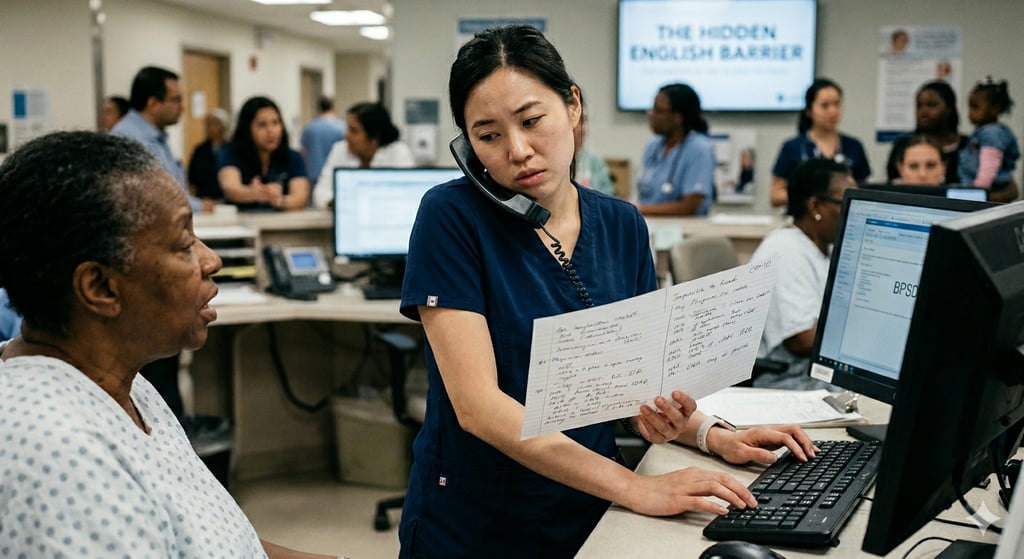
Sometimes the hardest part is nurse-to-nurse communication — specifically, phone handoff.
With patients, you can rely on facial expressions, gestures, lip reading, and context clues. Over the phone, all of that disappears.
When a nurse with a strong accent gives handoff by phone, it is genuinely brutal. You are trying to catch everything in real time: current medications, PRN (as-needed medications) use, vital signs, c/o pain or SOB (shortness of breath), whether the patient is A&Ox3 or has dropped to A&Ox2, any new physician orders, fall risk status, and safety concerns — all while your brain is still decoding pronunciation.
And that last one matters more than it sounds. A&Ox3 means the patient is alert and oriented to person, place, and time — all three confirmed. The moment it drops to A&Ox2, you need to know which one is missing and why. That is clinical information you cannot afford to mishear over a crackly phone line with a fast accent on the other end.
Missing something in handoff is not just uncomfortable. It is a patient safety issue.
That kind of pressure is exhausting. No IELTS test prepares you for a fast phone handoff at the end of a twelve-hour shift.
Canadian Nursing Documentation Has Its Own Language
Then there is charting.
Documentation in Canadian healthcare runs on abbreviations and shorthand. You learn them fast because you have to. PRN, NPO, SOB, c/o, O/E — these become second nature after a few months on the floor. But the diagnostic abbreviations take longer, because they carry more weight.
BPSD — Behavioral and Psychological Symptoms of Dementia — is something you will read and write constantly in long-term care. ESRD — End Stage Renal Disease — shows up in almost every complex patient file and shapes everything from fluid management to medication dosing. These are not just shorthand. They tell you the entire clinical picture in four letters.
Writing your own notes eventually gets easier because the language already exists in your head.
The harder part is reading everyone else's.
Every nurse develops slightly different charting habits. Some notes are clear. Others feel like solving a puzzle mid-shift. For international nurses, the challenge is often not the medical knowledge itself — it is learning how every workplace shortens, abbreviates, and compresses that knowledge into a few rushed lines.
You might see something like: pt c/o SOB, O/E A&Ox2 — disoriented to place, PRN given, ESRD hx noted — and you need to understand immediately what happened, what was done, and what still needs follow-up.
That kind of reading fluency does not come from any language course. It comes from months of exposure, and a lot of quietly Googling abbreviations between patients.
Why Physician Handwriting Still Feels Impossible to Read
And then there is the part everyone jokes about for a reason: physician handwriting.
I still do not understand why so many physicians seem determined to write in a style of cursive that is readable only to themselves. Rushed, abbreviated, occasionally borderline illegible — and yet somehow it ends up in an official medical record.
Sometimes the hardest part of the shift is not the patient care. It is decoding what a physician actually ordered.
When you combine shorthand, medical jargon, and handwritten notes, documentation becomes one of the most mentally exhausting parts of the day — especially when you are already twelve hours in.
The Real English Challenge for International Nurses in Canada
For international nurses, the hidden English barrier is rarely grammar.
It is speed. It is accent. It is context.
It is phone handoff with no visual cues. It is knowing that A&Ox2 is not the same as A&Ox3, and that you cannot ask the previous nurse to repeat herself a fourth time. It is reading a chart that says ESRD and BPSD and immediately knowing what kind of shift you are walking into.
It is the constant mental effort of turning unclear sound — or unclear writing — into safe patient care.
And even years later, I still find parts of it difficult.
You do get better. Your ears adjust. Your brain starts recognizing patterns faster. But the effort never fully disappears.
That is the part nobody explains before you start nursing in Canada.
Contact
Questions or stories? Reach out anytime.
Social media
contact@nurseincanada.com
© 2025. All rights reserved.
Will update.