What Surprised Me During My First Nursing Clinical in Canada (Coming from Korea)
LIFE
3/15/2026
What Surprised Me During My First Nursing Clinical in Canada (Coming from Korea)
One thing no one told me before my first nursing clinical in Canada: the job looks very different depending on where you're coming from.
I studied nursing in Korea before moving to Canada to begin my RPN program. Although I never completed a formal clinical placement there, my mother is a nurse and I spent a lot of time volunteering in hospitals growing up. I thought I had a decent sense of what nursing looked like.
Turns out, I knew what Korean nursing looked like.
Within the first few days of my clinical placement here, I realized how much my assumptions had been shaped by a completely different system.
Here is what genuinely caught me off guard — and what pleasantly surprised me too.
Total Patient Care Was a Culture Shock
In Korea, nursing roles are more narrowly defined. Nurses focus on clinical tasks — medications, injections, wound care, and managing admission and discharge paperwork. The more personal aspects of care, such as helping patients use the bathroom, bathing, or cleaning them after a bowel movement, are typically handled by family members or private caregivers hired by the patient's family.
Growing up around hospitals in Korea, I absorbed that model without even realizing it. That was simply what nurses did — and what they didn't do.
So when I started my clinical placement in Canada and saw that nurses were expected to help with toileting, perineal care, full bed baths, and linen changes, I was genuinely shocked.
I remember thinking, Do I really have to do this?
And then I actually had to do it. There were moments I had simply never thought about before — like the physical reality of bathing an elderly patient, or performing perineal care properly after a bowel movement. My preceptor had to show me things I didn't even know I didn't know. I had mentally prepared for medications and procedures. I had not prepared for this.
Nurses Here Also Handle the Unexpected
Another moment that stood out: if a patient had an accident on the floor, the nurse or care staff would often clean it up first, before environmental services came in to sanitize. The first time I saw that, I was caught off guard. In Korea, that initial response would typically be someone else's responsibility.
It was not a dramatic moment, but it shifted something in how I understood the nursing role here. Nurses in Canada seem to take broader responsibility for the patient's overall environment — not just the clinical tasks.
The Nurse-to-Patient Ratio Made a Real Difference
Not everything surprised me in a difficult way.
The nurse-to-patient ratio in Canada was something I had heard about before arriving, but experiencing it firsthand was different. In Korea, one nurse may be responsible for around 15 patients during a single shift. During my clinical placement here, nurses were typically assigned four or five patients.
That difference changes everything — the pace of care, how thoroughly you can assess each patient, and how safe the environment feels for both nurses and patients.
Nurses Are Treated as Professionals Here
This was perhaps the most meaningful difference to me.
From what I observed in Korean hospitals, nurses are sometimes treated as subordinates to physicians. Patients will frequently ignore what a nurse says and ask to speak directly to the doctor. The input of nurses is not always taken seriously, even when it matters clinically.
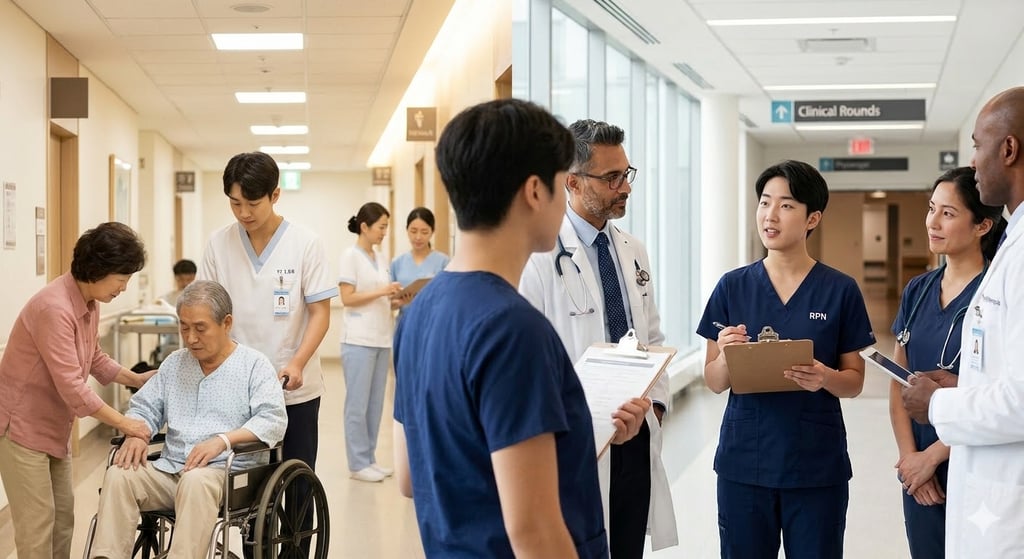
In Canada, I saw something different firsthand. During clinical rounds, nurses, physicians, social workers, and physiotherapists would gather to discuss each patient — and the nurse's input was actively sought out. Not tolerated. Actually asked for. That moment stuck with me. It made me realize that nursing here is treated as a genuine professional voice within the healthcare team, not just a supporting role.
Looking Back
My first clinical in Canada challenged many of the assumptions I had about nursing — assumptions built from years of observing the healthcare system in Korea.
Some adjustments were harder than I expected. Others reminded me why I wanted to do this work in the first place.
If you grew up around healthcare in Korea, or studied nursing there before coming to Canada, you might find the transition more surprising than you expect — even if you think you already know what hospitals look like.
I certainly did.
Contact
Questions or stories? Reach out anytime.
Social media
contact@nurseincanada.com
© 2025. All rights reserved.
Will update.