IELTS vs CELBAN for Nurses in Canada: Which One Do You Actually Need?
IMMIGRATION
4/7/2026
IELTS vs CELBAN for Nurses in Canada: Which One Do You Actually Need?
A clear breakdown for international nurses and future nursing students — without the confusion
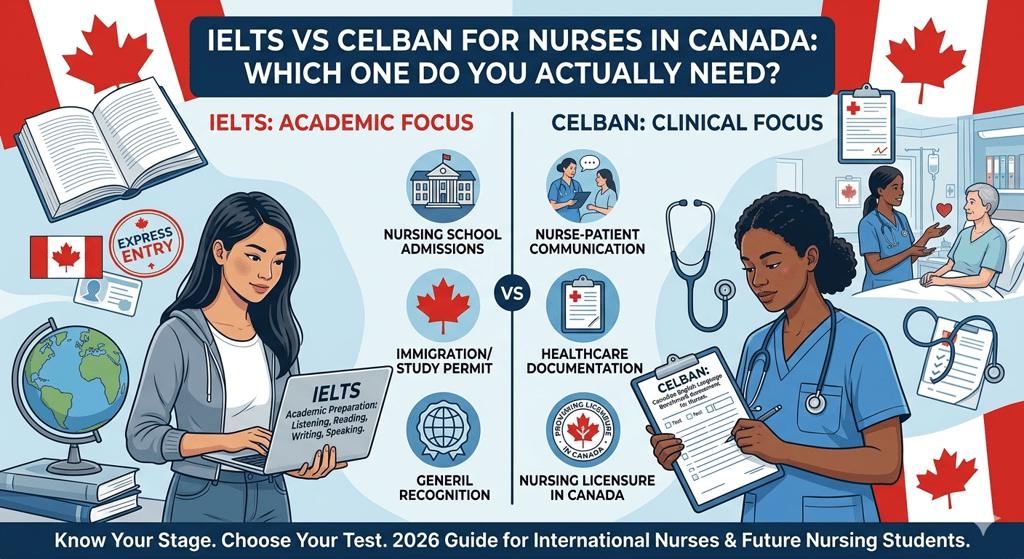
If you're planning to work or study nursing in Canada, you've probably come across both IELTS and CELBAN at some point. Both test English. Both are accepted in Canada. But they are not interchangeable — and treating them like they are is where people get stuck.
Most resources list them side by side as if you just pick whichever sounds easier. That framing misses the point entirely. The test you need isn't about difficulty — it's about where you are in the process.
What Is IELTS?
IELTS (International English Language Testing System) is the most widely used English proficiency test in Canada, and globally.
It covers four components — Reading, Writing, Listening, and Speaking — and it's accepted across nursing school admissions, immigration applications, and provincial nursing licensure.
For most people, IELTS is the default starting point — even if they later switch paths.
A few specifics worth knowing:
Nursing school admissions: most programs require IELTS Academic with an overall score around 6.5
Nursing licensure: the bar is higher — typically an overall 7.0, with 7.0 in Speaking and Writing, 7.5 in Listening, and 6.5 in Reading (requirements vary slightly by province)
Results: available within 3–13 days depending on paper or computer format
Validity: two years from test date
What Is CELBAN?
CELBAN (Canadian English Language Benchmark Assessment for Nurses) is a specialized test built specifically for internationally educated nurses seeking licensure in Canada.
The content is clinical — nurse-patient communication, healthcare documentation, and medical scenarios. If you've been working as a nurse, the material will feel familiar in a way that general academic English tests don't.
It's accepted by provincial nursing regulatory bodies as an alternative to IELTS Academic for licensing purposes. Results take four to six weeks.
One important detail: CELBAN is only recognized in Canada. If your plans ever extend beyond Canada, IELTS gives you far more flexibility.
If you're not already a nurse, CELBAN is not relevant to you — at least not yet.
The Real Difference — It's About What Stage You're At
The licensing row is where people tend to overthink it. If you're an internationally educated nurse going through the licensing process, you can choose either test — most nurses pick one and stick with it. Some take IELTS first for immigration, then opt for CELBAN later. But in most cases, one is enough.
Do You Need Both?
Almost certainly not.
If you're a student coming to Canada to study nursing: IELTS. CELBAN is not used for undergraduate nursing program admissions.
If you're already a trained nurse coming to get licensed: CELBAN or IELTS Academic, your choice. Pick whichever format plays to your strengths.
If you're unsure, IELTS is usually the safer starting point — it covers more ground and keeps your options open.
My Path: I Didn't Take Either
Here's something that doesn't come up enough in these comparisons.
I didn't take IELTS or CELBAN — which is unusual, and something I didn't even fully realize at the time. I came through a language school pathway before entering nursing school in Canada, and that route worked for me.
Language school pathways can offer a more gradual transition into academic English, and some programs accept pathway completion in place of a standardized test score. But they're not available at every school, they depend on your academic background, and not all pathways are equal.
The point is — IELTS and CELBAN aren't the only two ways into this system. Know what options exist before you commit to one approach.
Which One Should You Choose?
Choose IELTS if you are:
Applying to nursing school as a student
Going through Canadian immigration
Unsure about your long-term plans
Choose CELBAN if you are:
Already a trained nurse seeking Canadian licensure
Confident you'll be practicing in Canada specifically
More comfortable with healthcare-specific exam content
If you're starting from scratch — no nursing degree yet, planning to study in Canada — you almost certainly need IELTS, not CELBAN.
If you're still unsure, IELTS is usually the safer starting point.
Common Mistakes Worth Avoiding
Preparing for CELBAN when applying to nursing school — it's not used for undergraduate admissions
Assuming your nursing school IELTS score meets the licensing threshold — a 6.5 for school admission often isn't enough for licensure; the requirements are different
Not checking your specific province — regulatory bodies vary, and some accept additional tests like OET or PTE Academic alongside IELTS and CELBAN
Treating the two-year validity as a long window — two years goes faster than expected once applications, assessments, and scheduling delays stack up
The Bottom Line
IELTS and CELBAN are both legitimate, well-recognized tests — but they're tools for different stages of the same journey.
The test you need isn't about which one is easier. It's about timing — where you are right now, and what you're actually applying for.
Student heading into nursing school: IELTS. Trained nurse seeking Canadian licensure: CELBAN or IELTS Academic.
Know your stage. That's the decision.
Questions about specific provinces or programs? Drop them in the comments.
--------------------------------------------------------------------------------------------------------------
[Next Steps for Your English Journey:]
Real-world Survival: Think passing IELTS is enough? Here’s what clinical English actually feels like: [The Hidden English Barrier for Nurses in Canada]
Application Readiness: If you're taking IELTS for school, make sure you've checked off the rest of this list: [How to Prepare Before Starting Nursing School]
--------------------------------------------------------------------------------------------------------------

IELTS vs CELBAN for Nurses in Canada: Which One Do You Actually Need?
A clear breakdown for international nurses and future nursing students — without the confusion
If you're planning to work or study nursing in Canada, you've probably come across both IELTS and CELBAN at some point. Both test English. Both are accepted in Canada. But they are not interchangeable — and treating them like they are is where people get stuck.
Most resources list them side by side as if you just pick whichever sounds easier. That framing misses the point entirely. The test you need isn't about difficulty — it's about where you are in the process.
What Is IELTS?
IELTS (International English Language Testing System) is the most widely used English proficiency test in Canada, and globally.
It covers four components — Reading, Writing, Listening, and Speaking — and it's accepted across nursing school admissions, immigration applications, and provincial nursing licensure.
For most people, IELTS is the default starting point — even if they later switch paths.
A few specifics worth knowing:
Nursing school admissions: most programs require IELTS Academic with an overall score around 6.5
Nursing licensure: the bar is higher — typically an overall 7.0, with 7.0 in Speaking and Writing, 7.5 in Listening, and 6.5 in Reading (requirements vary slightly by province)
Results: available within 3–13 days depending on paper or computer format
Validity: two years from test date
What Is CELBAN?
CELBAN (Canadian English Language Benchmark Assessment for Nurses) is a specialized test built specifically for internationally educated nurses seeking licensure in Canada.
The content is clinical — nurse-patient communication, healthcare documentation, and medical scenarios. If you've been working as a nurse, the material will feel familiar in a way that general academic English tests don't.
It's accepted by provincial nursing regulatory bodies as an alternative to IELTS Academic for licensing purposes. Results take four to six weeks.
One important detail: CELBAN is only recognized in Canada. If your plans ever extend beyond Canada, IELTS gives you far more flexibility.
If you're not already a nurse, CELBAN is not relevant to you — at least not yet.
The Real Difference — It's About What Stage You're At
The licensing row is where people tend to overthink it. If you're an internationally educated nurse going through the licensing process, you can choose either test — most nurses pick one and stick with it. Some take IELTS first for immigration, then opt for CELBAN later. But in most cases, one is enough.
Do You Need Both?
Almost certainly not.
If you're a student coming to Canada to study nursing: IELTS. CELBAN is not used for undergraduate nursing program admissions.
If you're already a trained nurse coming to get licensed: CELBAN or IELTS Academic, your choice. Pick whichever format plays to your strengths.
If you're unsure, IELTS is usually the safer starting point — it covers more ground and keeps your options open.
My Path: I Didn't Take Either
Here's something that doesn't come up enough in these comparisons.
I didn't take IELTS or CELBAN — which is unusual, and something I didn't even fully realize at the time. I came through a language school pathway before entering nursing school in Canada, and that route worked for me.
Language school pathways can offer a more gradual transition into academic English, and some programs accept pathway completion in place of a standardized test score. But they're not available at every school, they depend on your academic background, and not all pathways are equal.
The point is — IELTS and CELBAN aren't the only two ways into this system. Know what options exist before you commit to one approach.
Which One Should You Choose?
Choose IELTS if you are:
Applying to nursing school as a student
Going through Canadian immigration
Unsure about your long-term plans
Choose CELBAN if you are:
Already a trained nurse seeking Canadian licensure
Confident you'll be practicing in Canada specifically
More comfortable with healthcare-specific exam content
If you're starting from scratch — no nursing degree yet, planning to study in Canada — you almost certainly need IELTS, not CELBAN.
If you're still unsure, IELTS is usually the safer starting point.
Common Mistakes Worth Avoiding
Preparing for CELBAN when applying to nursing school — it's not used for undergraduate admissions
Assuming your nursing school IELTS score meets the licensing threshold — a 6.5 for school admission often isn't enough for licensure; the requirements are different
Not checking your specific province — regulatory bodies vary, and some accept additional tests like OET or PTE Academic alongside IELTS and CELBAN
Treating the two-year validity as a long window — two years goes faster than expected once applications, assessments, and scheduling delays stack up
The Bottom Line
IELTS and CELBAN are both legitimate, well-recognized tests — but they're tools for different stages of the same journey.
The test you need isn't about which one is easier. It's about timing — where you are right now, and what you're actually applying for.
Student heading into nursing school: IELTS. Trained nurse seeking Canadian licensure: CELBAN or IELTS Academic.
Know your stage. That's the decision.
Questions about specific provinces or programs? Drop them in the comments.
--------------------------------------------
[Next Steps for Your English Journey:]
Real-world Survival: Think passing IELTS is enough? Here’s what clinical English actually feels like: [The Hidden English Barrier for Nurses in Canada]
Application Readiness: If you're taking IELTS for school, make sure you've checked off the rest of this list: [How to Prepare Before Starting Nursing School]
--------------------------------------------
Contact
Questions or stories? Reach out anytime.
Social media
contact@nurseincanada.com
© 2025. All rights reserved.
Will update.