NNAS vs Studying Nursing in Canada: An Honest Guide for 2026
IMMIGRATION
3/27/2026
NNAS vs Studying Nursing in Canada: An Honest Guide for 2026
If you're an internationally educated nurse — or someone who started nursing school but didn't finish — you've probably come across NNAS while researching how to work as a nurse in Canada.
And you've probably wondered: Does this apply to me? Do I even qualify?
This is where most guides get it wrong. So let's start with the part that actually matters.
1. What NNAS Actually Is (And Who It's For)
NNAS (National Nursing Assessment Service) is a Canadian non-profit that evaluates the nursing credentials of internationally educated nurses. It doesn't give you a license — it produces an Advisory Report, which you then submit to the nursing regulatory body in your province.
There are two types of service:
Expedited Service — requires a completed nursing program and a nursing license from your home country. Once all documents are received, the Advisory Report is issued within 5 business days.
Regular Service — requires only a completed nursing program. No license needed. The report is issued within 12 weeks of all documents being received.
In both cases, the requirement is the same: you must have fully completed your nursing program abroad. If you only completed part of your degree, you are not eligible for either service.
If you're unsure whether you qualify, check the official NNAS eligibility requirements directly — particularly around education completion and licensing status, as the criteria differ between services.
2. Why I Wasn't Eligible — And What I Did Instead
I started a four-year RN program in Korea. I completed two years.
That meant no degree, no license, and no path through NNAS. It wasn't a calculated strategy. It was just the reality of where I was.
So I made a decision: come to Canada and start an RPN program here.
At the time it didn't feel like a plan. It felt like the only realistic option available to me.
3. What Studying Nursing in Canada Was Actually Like
On paper, studying nursing in Canada as an international student sounds manageable. In practice, it comes with a specific kind of pressure that doesn't show up in program brochures.
The hardest part: English
Not just in the classroom — in clinical placements, in patient handoffs, and in everyday conversations with coworkers. Nursing English is a different challenge from the English you study for an exam like IELTS. You can score well on a test and still struggle to communicate clearly during a code or a rapid handoff. Even after more than eight years of working as a nurse in Canada, English is something I still actively work on. That part doesn't end when you graduate.
The second hardest part: money
This doesn't get talked about enough. I had to keep working while studying. Tuition, rent, daily expenses — none of it pauses because you're in school. It was always both at the same time: studying and working, working and studying. That kind of pressure builds up quietly and doesn't really let go.
4. What If I Had Stayed and Finished in Korea?
I've thought about this.
If I had stayed and completed the remaining two years, I would have graduated with a full RN degree. If work experience was required to move abroad as a nurse, I would have started building that in Korea. By the time I had the degree and the experience, I'd likely have been in my mid-twenties — maybe in a relationship, maybe settled into a job, maybe just comfortable enough that leaving no longer felt necessary.
Would I have come to Canada? Honestly, I'm not sure.
The longer you wait, the more life fills in around you. And sometimes the thing that keeps people from leaving isn't fear — it's just that everything they've built starts to make leaving feel less and less worth it.
5. The Thing Nobody Talks About: Timing
Most comparisons between NNAS and studying in Canada focus on cost and speed. That's useful. But it misses something more important.
The real question is: when are you making the move?
Leaving earlier meant I didn't accumulate two more years of reasons to stay. I didn't finish something that would have felt too significant to walk away from. I didn't build a version of my life in Korea that would have made starting over in Canada feel like too much of a loss.
6. A Realistic Comparison
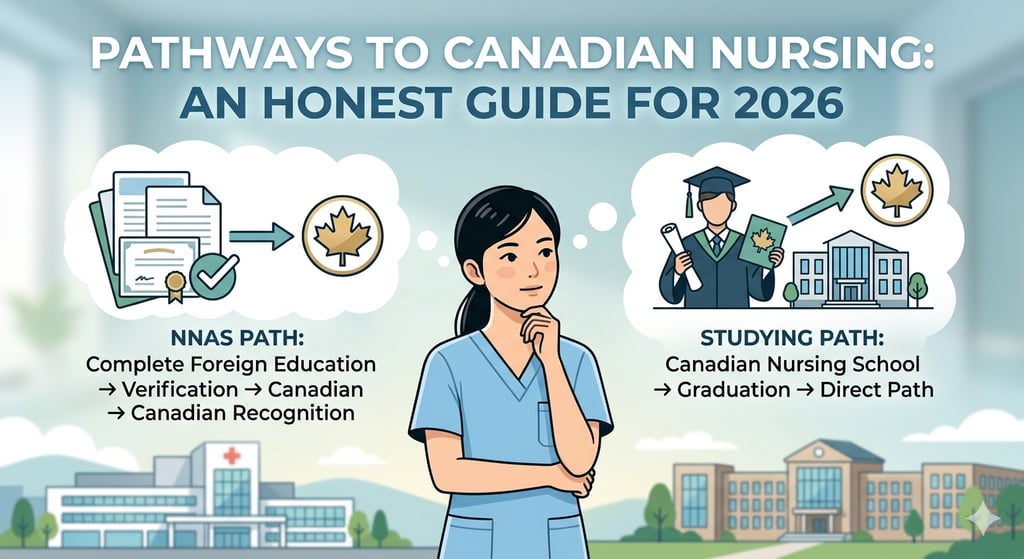
NNAS makes sense if you've already completed your full nursing program abroad and want your credentials recognized without repeating your education.
Studying in Canada makes more sense if you haven't finished your degree, or if you want a credential built directly within the Canadian system from the start.
Curious about the reality of nursing school in Canada? Check out this honest perspective for international students:[How Hard Is Nursing School in Canada? An Honest Perspective for International Students]
7. Where I Am Now
I've been working as an RPN (Registered Practical Nurse) in Canada for over eight years. Most of that time was spent as a bedside nurse in hospital settings. Recently, I moved into a management role as an ADOC — Associate Director of Care — overseeing nursing care and operations in a care facility.
I'm also currently working toward my RN through a bridging program — something I wouldn't have been able to consider without the foundation I built here first.
I'm not sharing this to make the path sound easy — it wasn't. English was a constant challenge. Money was a constant pressure. There were plenty of moments where I questioned whether the decision made sense.
But looking back, I think the most important thing wasn't which path I chose. It was that I made the move when I still could — before finishing school, before building a career in Korea, before having enough reasons to stay that leaving became the harder choice.
I'm satisfied with where I am now. And I think a big part of that comes down to timing.
Final Thoughts
If you're deciding between NNAS and studying in Canada, start with the basics: have you completed your full nursing program? Do you hold a license in your home country?
If yes to both — NNAS is worth looking into seriously.
If you haven't finished your degree, like I hadn't — then studying in Canada isn't a backup plan. It's just the path that's actually open to you.
And sometimes that's reason enough to start.
Still not sure which path to take? Check out this realistic guide: [Should You Study Nursing in Canada or Go Through NNAS?]
NNAS vs Studying Nursing in Canada: An Honest Guide for 2026
If you're an internationally educated nurse — or someone who started nursing school but didn't finish — you've probably come across NNAS while researching how to work as a nurse in Canada.
And you've probably wondered: Does this apply to me? Do I even qualify?
This is where most guides get it wrong. So let's start with the part that actually matters.
1. What NNAS Actually Is (And Who It's For)
NNAS (National Nursing Assessment Service) is a Canadian non-profit that evaluates the nursing credentials of internationally educated nurses. It doesn't give you a license — it produces an Advisory Report, which you then submit to the nursing regulatory body in your province.
There are two types of service:
Expedited Service — requires a completed nursing program and a nursing license from your home country. Once all documents are received, the Advisory Report is issued within 5 business days.
Regular Service — requires only a completed nursing program. No license needed. The report is issued within 12 weeks of all documents being received.
In both cases, the requirement is the same: you must have fully completed your nursing program abroad. If you only completed part of your degree, you are not eligible for either service.
If you're unsure whether you qualify, check the official NNAS eligibility requirements directly — particularly around education completion and licensing status, as the criteria differ between services.
2. Why I Wasn't Eligible — And What I Did Instead
I started a four-year RN program in Korea. I completed two years.
That meant no degree, no license, and no path through NNAS. It wasn't a calculated strategy. It was just the reality of where I was.
So I made a decision: come to Canada and start an RPN program here.
At the time it didn't feel like a plan. It felt like the only realistic option available to me.
3. What Studying Nursing in Canada Was Actually Like
On paper, studying nursing in Canada as an international student sounds manageable. In practice, it comes with a specific kind of pressure that doesn't show up in program brochures.
The hardest part: English
Not just in the classroom — in clinical placements, in patient handoffs, and in everyday conversations with coworkers. Nursing English is a different challenge from the English you study for an exam like IELTS. You can score well on a test and still struggle to communicate clearly during a code or a rapid handoff. Even after more than eight years of working as a nurse in Canada, English is something I still actively work on. That part doesn't end when you graduate.
The second hardest part: money
This doesn't get talked about enough. I had to keep working while studying. Tuition, rent, daily expenses — none of it pauses because you're in school. It was always both at the same time: studying and working, working and studying. That kind of pressure builds up quietly and doesn't really let go.
4. What If I Had Stayed and Finished in Korea?
I've thought about this.
If I had stayed and completed the remaining two years, I would have graduated with a full RN degree. If work experience was required to move abroad as a nurse, I would have started building that in Korea. By the time I had the degree and the experience, I'd likely have been in my mid-twenties — maybe in a relationship, maybe settled into a job, maybe just comfortable enough that leaving no longer felt necessary.
Would I have come to Canada? Honestly, I'm not sure.
The longer you wait, the more life fills in around you. And sometimes the thing that keeps people from leaving isn't fear — it's just that everything they've built starts to make leaving feel less and less worth it.
5. The Thing Nobody Talks About: Timing
Most comparisons between NNAS and studying in Canada focus on cost and speed. That's useful. But it misses something more important.
The real question is: when are you making the move?
Leaving earlier meant I didn't accumulate two more years of reasons to stay. I didn't finish something that would have felt too significant to walk away from. I didn't build a version of my life in Korea that would have made starting over in Canada feel like too much of a loss.
6. A Realistic Comparison
NNAS makes sense if you've already completed your full nursing program abroad and want your credentials recognized without repeating your education.
Studying in Canada makes more sense if you haven't finished your degree, or if you want a credential built directly within the Canadian system from the start.
Curious about the reality of nursing school in Canada? Check out this honest perspective for international students:[How Hard Is Nursing School in Canada? An Honest Perspective for International Students]
7. Where I Am Now
I've been working as an RPN (Registered Practical Nurse) in Canada for over eight years. Most of that time was spent as a bedside nurse in hospital settings. Recently, I moved into a management role as an ADOC — Associate Director of Care — overseeing nursing care and operations in a care facility.
I'm also currently working toward my RN through a bridging program — something I wouldn't have been able to consider without the foundation I built here first.
I'm not sharing this to make the path sound easy — it wasn't. English was a constant challenge. Money was a constant pressure. There were plenty of moments where I questioned whether the decision made sense.
But looking back, I think the most important thing wasn't which path I chose. It was that I made the move when I still could — before finishing school, before building a career in Korea, before having enough reasons to stay that leaving became the harder choice.
I'm satisfied with where I am now. And I think a big part of that comes down to timing.
Final Thoughts
If you're deciding between NNAS and studying in Canada, start with the basics: have you completed your full nursing program? Do you hold a license in your home country?
If yes to both — NNAS is worth looking into seriously.
If you haven't finished your degree, like I hadn't — then studying in Canada isn't a backup plan. It's just the path that's actually open to you.
And sometimes that's reason enough to start.
Still not sure which path to take? Check out this realistic guide: [Should You Study Nursing in Canada or Go Through NNAS?]
Contact
Questions or stories? Reach out anytime.
Social media
contact@nurseincanada.com
© 2025. All rights reserved.
Will update.